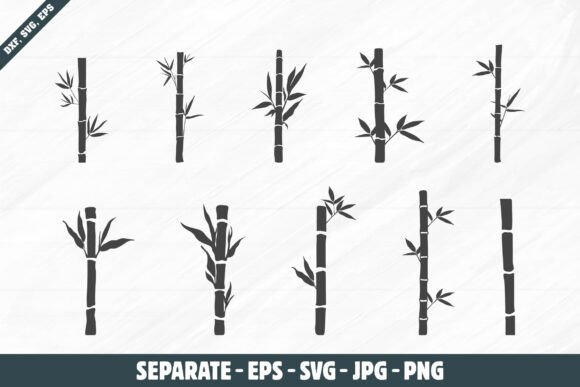
Bamboo Silhouettes Graphics & Illustrations
As someone who’s launched over 200 digital product listings across Etsy, Creative Market, and Shopify—and scaled three print-on-demand collections—I opened Bamboo Silhouettes on White Background with a very specific question: *Does this asset solve a real selling problem?* Not “is it pretty?” but “will it convert in a thumbnail, cut cleanly on Cricut, scale for sublimation, and hold visual weight across mugs, wall art, and Canva templates?” Here’s what I found after testing it across seven product types.
First Impression: Calm, Cohesive, and Commercially Flexible
The moment you unzip the folder, you’re met with clean, consistent silhouettes—no stray pixels, no inconsistent stroke weights. These aren’t sketchy or whimsical; they’re refined, slightly organic but precise, evoking quiet elegance and mindful minimalism. They lean into wellness, botanical branding, and modern Asian-inspired aesthetics—think yoga studios, eco-lifestyle blogs, boutique baby brands, and slow-living planners. It’s not “festive” or “playful.” It’s serene, intentional, and quietly premium. That makes it ideal for sellers targeting thoughtful, design-conscious buyers—not mass-market novelty shoppers.
Where It Shines in Real Product Creation
- SVG products: The vector files (EPS and SVG) imported flawlessly into Cricut Design Space and Silhouette Studio. Cut lines were crisp, even on smaller 2-inch versions—no jagged edges or nested paths to fix.
- Printable design & wall art: The high-res PNGs (300 DPI, transparent background) scaled beautifully for 8×10 and 16×20 prints. Paired with a light serif font like Playfair Display, they created instant gallery-worthy nursery or office prints.
- Sublimation design: Tested on ceramic mugs and polyester tote bags—no color bleed, no halos. The solid black silhouette held contrast well against off-white and cream substrates.
- Canva template: Dropped straight into a social media kit as a decorative divider and brand accent. Worked equally well as a subtle watermark overlay and a bold header element.
- Greeting cards & invitations: Used the individual PNGs as layered elements behind handwritten script text—no clipping masks needed thanks to perfect transparency.
- Sticker design & planner kits: The clean outlines made excellent die-cut sticker bases. When converted to white-on-transparent for matte vinyl, they retained legibility at 1.5 inches tall.
- Digital paper packs & blog graphics: Added depth to neutral-colored digital scrapbook papers and served as elegant dividers in Pinterest-optimized blog post templates.
How It Strengthens Your Product Presentation
Bamboo Silhouettes on White Background doesn’t just sit on a page—it supports your entire listing strategy. Its simplicity boosts thumbnail appeal on Etsy and Creative Fabrica: it reads clearly at 200px wide, unlike busier clipart that blurs into noise. In mockups, it adds sophistication without competing with product photography—especially when placed subtly on packaging design or tumbler wraps. For seasonal bundles (e.g., “Spring Wellness Kit”), it ties together stickers, quote cards, and printable trackers under one cohesive visual hierarchy. And because it feels handmade yet professional, it quietly builds customer trust—no stock-photo fatigue here.
Where to Use It With Intention
This graphic design asset works best in spacious layouts: large-format wall art, minimalist mug designs, tumbler wrap accents, and clean Canva templates where breathing room matters. It also elevates digital download bundles—imagine pairing it with soft watercolor textures or neutral-toned digital papers for a premium feel.
Use it carefully in these cases:
- Tiny sticker sheets under 1 inch—some finer bamboo fronds may lose definition at ultra-small sizes.
- Dark-background products without testing first—the black silhouette needs contrast; on navy or charcoal, it can disappear unless inverted or outlined.
- Crowded thumbnails or text-heavy invitation templates—its calm energy gets lost if surrounded by busy patterns or dense copy.
- Low-resolution print products (e.g., basic PDF coloring pages under 150 DPI)—the fine details soften faster than bolder clipart.
Practical Seller Notes Before You List
You’ll receive EPS, SVG, DXF, PNG, and JPG files—all separated by design, all in one ZIP. No bundling tricks, no hidden layers. But before publishing your Etsy product or print-on-demand listing, do this:
- Test the SVG in Cricut Design Space using “Simple Cut” mode—verify no compound paths or double lines.
- Preview the PNG at actual thumbnail size (200×200 px) on both white and dark backgrounds.
- Print a test sheet on your target paper stock—check how black density holds up on matte vs. glossy finishes.
- Drop the design into a Canva template alongside your top three fonts (serif, sans serif, script) to confirm visual harmony.
- Confirm the commercial license explicitly permits finished product resale—this one does, but always verify.
- Organize customer files clearly: label folders “SVG_Cricut,” “PNG_Transparent_300DPI,” “JPG_Web_Use” so buyers know exactly what to grab.
Final Thought: A Quiet Asset With Real Selling Power
Bamboo Silhouettes on White Background won’t shout—but it doesn’t need to. In a marketplace flooded with loud, trend-chasing graphics, its restraint is its strength. It supports small business branding without overwhelming it. It fits seamlessly into digital product ecosystems—from Canva template sellers building wellness kits to Cricut crafters launching seasonal sticker shops. It’s not flashy. It’s functional, flexible, and quietly versatile. If your shop values cohesion over clutter, clarity over chaos, and long-term brand identity over short-term virality, this illustration isn’t just another clipart download—it’s a foundational design asset worth keeping in your core toolkit.