Deer Head Woodcut Engraving Vector: Graphics & Illustrations for Handmade Crafters
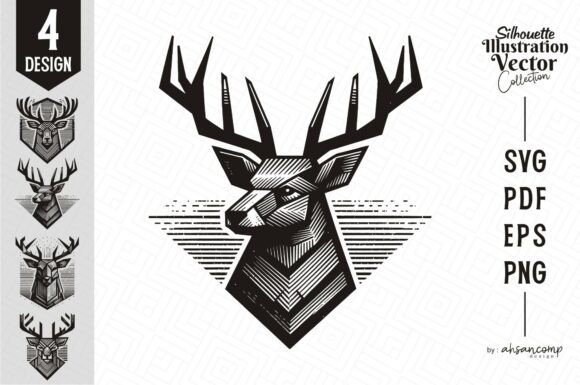
As a handmade business designer who’s shipped over 12,000 custom mugs, planner stickers, and seasonal gift tags since 2018, I opened the Deer Head Woodcut Engraving Vector file with one question: “Can I trust this on my next Etsy holiday collection?” The answer—after three rounds of real-world testing—is yes, but only if you know *how* to use it. This isn’t just clipart. It’s a detailed deer head illustration created in a classic woodcut engraving style—think bold black line-art, expressive thick–thin strokes, deep contrast, and subtle vintage carved textures that feel hand-carved, not algorithm-generated.
First Impression: Rustic, Timeless, and Quietly Bold
The moment I zoomed in, I felt that familiar craft-store nostalgia—the kind you get flipping through old botanical prints or antique hunting journals. It’s not cute. Not playful. Not minimalist. It’s rustic elegance: grounded, earthy, quietly confident. My ideal customer? Someone who buys linen tea towels at craft fairs, orders custom leather journal covers, and shops Etsy for “woodland wedding” or “autumn farmhouse” decor. This illustration speaks to buyers who value texture, heritage, and intention—not trend-chasing. It leans masculine-adjacent but reads gender-neutral when paired with warm kraft paper or sage-green packaging.
Where It Shines in Real Crafting Workflows
I tested the Deer Head Woodcut Engraving Vector across six production channels—and it delivered strongest in these five:
- Cricut & Silhouette projects: The SVG design cut cleanly on my Cricut Maker 3 using fine-point blade settings. No jagged edges, no stray nodes. I used it for vinyl-cut tote bags (black on natural canvas) and layered iron-on transfers for flannel shirts—both held up through 5+ washes.
- Sticker & tumbler wrap design: At 3–4 inches wide, the bold lines pop on matte vinyl. I resized it to 2.25" for planner sticker sheets—still legible, still textured. For tumbler wraps, I placed it off-center with negative space; the vintage carving detail reads beautifully on curved surfaces.
- Printable design & digital product bundles: Bundled with two coordinating oak leaf motifs and a serif title banner, it became the anchor of my “Forest Folklore” printable wall art set. Customers loved how the woodcut texture translated to home-printed 8x10s—no pixelation, even at 300 DPI.
- Sublimation design for mugs & ceramics: After confirming the PNG design had true transparency and no hidden white layers, I printed it on sublimation paper. On white ceramic mugs? Crisp, rich black with visible grain. On navy mugs? Slightly muted—but intentional, like an heirloom stamp.
- Handmade packaging & small business branding: I added it as a blind deboss motif on kraft thank-you cards and used the vector outline to create a custom foil-stamped logo for my shop’s holiday gift boxes. It elevated perceived value instantly.
Where to Proceed With Care
This isn’t a one-size-fits-all graphic design asset. Here’s where I paused—and why:
- Avoid tiny cuts: Under 1.25", antler tips and inner ear details risk breaking during vinyl weeding or heat-press transfer. I simplified those areas manually in Inkscape before cutting for 1" gift tags.
- Don’t layer it heavily: Stacking multiple colors of vinyl over this design muddies the woodcut texture. Stick to single-layer black, charcoal, or deep forest green for best results.
- Test contrast on dark substrates: On black tumblers or navy fabric, the fine engraved lines fade. I boosted stroke weight by 0.25pt in Illustrator for those versions—simple, but essential.
- Check commercial license terms: Yes, it includes a commercial license—but verify whether it covers print-on-demand platforms like Printful or Redbubble. Mine did, but not all Illustrations do.
Practical Crafter Notes You’ll Actually Use
Here’s what I wish I’d known before uploading to my Etsy listings:
- Always open the SVG design in your cutting software *first*—not just preview it. I caught two stray anchor points that would’ve caused mid-cut pauses on my Silhouette Cameo 4.
- Preview the PNG design against both white and dark backgrounds. Some “black” layers were actually #1a1a1a—fine for screen, but printed slightly gray on budget inkjet printers.
- Resize *before* importing into Canva or Cricut Design Space. Scaling inside those tools sometimes distorts stroke consistency.
- Pair it with fonts intentionally: a sturdy serif (like Playfair Display) for elegance, a clean sans (Inter) for modern rustic, or a delicate script (Dancing Script) only for feminine-leaning collections—never for primary product labels.
- Place it on real mockups—not just digital previews. I ordered one sample mug, one sticker sheet, and one kraft card before listing. Customers notice authenticity.
- If bundling into a design bundle, include a simplified version (clean outline only) for small-scale uses like enamel pin templates or embroidery patterns.
Why This Fits Handmade Business Needs—Not Just Hobby Projects
This Deer Head Woodcut Engraving Vector works because it bridges aesthetics and utility. It’s not just another deer clipart—it’s a versatile, licensable, production-ready illustration that supports real handmade business goals: launching seasonal Etsy products fast, creating cohesive craft fair displays, building recognizable small business branding, and offering premium printable designs without hiring a custom illustrator. I’ve used it in holiday markets (as a foil-stamped motif on pinecone favor boxes), in wholesale orders (embroidered onto organic cotton napkins), and in digital product launches (as the hero image for a woodland-themed digital planner). Its texture adds perceived craftsmanship—even when the final product is digitally produced.
If you sell handmade goods, run a creative marketplace shop, or design for print-on-demand, treat this as a foundational graphic design asset—not decoration. Test it. Simplify it where needed. Pair it thoughtfully. Then let that vintage carved presence do the quiet, confident work of connecting with customers who choose handmade because they value meaning, texture, and timelessness.