Silhouette of a Woman with Flower Hair
A Design That Breathes—Not Just Decorates
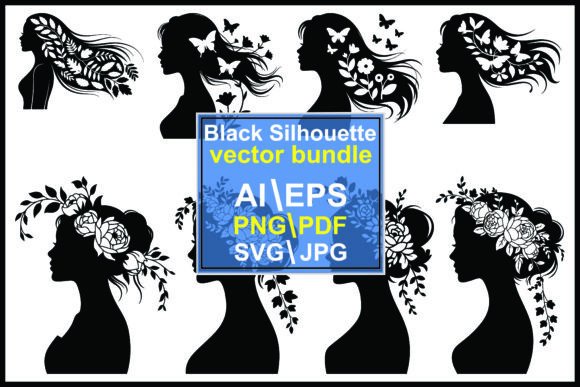
When I first opened Silhouette of a Woman with Flower Hair, I didn’t see a graphic—I saw movement. The profile is clean and confident, but it’s the hair-as-nature motif—branches curling into leaves, blossoms emerging organically from the crown—that gives it quiet intention. This isn’t a clipart afterthought; it’s an illustration built for resonance. As a designer who’s stitched hundreds of custom pieces for Etsy sellers, boutique aprons, and baby milestone blankets, I immediately pictured it on a linen tea towel: soft, botanical, quietly elegant—not loud, not trendy, but deeply *keepable*.
Where It Shines in Real Embroidery Projects
Silhouette of a Woman with Flower Hair lands beautifully on medium-to-heavyweight natural fabrics. I tested it on a heavyweight cotton tote bag last week—no puckering, no distortion—and the negative space around the silhouette held its shape even with dense fill stitches in the floral elements. It reads clearly at 3.5" wide, making it ideal for sweatshirt chest placements, pillow covers, and embroidered patches meant for denim jackets or canvas backpacks.
For baby embroidery? Yes—but with nuance. On a cotton onesie, I’d recommend simplifying the inner leaf details via digitizing adjustments (or choosing a lighter stitch density) to avoid stiffness. On a muslin nursery wall hanging? Perfect as-is. Its black-and-white organic theme translates effortlessly to gender-neutral gifting—think holiday embroidery for new parents or wedding guest favors styled with dried lavender and linen.
Etsy sellers will appreciate how well Silhouette of a Woman with Flower Hair photographs in printable mockups. The strong contrast and clear outlines mean your digital embroidery file previews pop without heavy editing. It also scales gracefully: shrink it to 2" for a cap front or expand to 5" for a kitchen towel monogram panel, and the balance between figure and flora holds.
Where Caution Is Part of the Craft
This design doesn’t hide its intricacy—and that’s both its strength and its boundary. On thin or stretchy fabric like jersey tees or lightweight rayon, the fine branch lines and clustered flower shapes risk distortion during hooping or stitching. I wouldn’t use it raw on a curved cap surface without re-digitizing the curve alignment or reducing stitch density in the hair’s outer tendrils.
Dark fabric demands attention too. While the black silhouette reads powerfully on cream or oat linen, it can lose definition on charcoal or navy unless you add a subtle white underlay or switch to a tonal thread (e.g., deep forest green on black). And on textured fabrics—bouclé, terry cloth, or heavily napped fleece—the delicate leaf edges may blur visually, so always test on scrap first.
Also worth noting: this is an illustration, not an applique design. There are no built-in satin-stitch borders or layered fabric cutlines. If you’re planning an embroidered patch with clean edges, you’ll need to add a border stitch manually—or pair it with a simple running-stitch outline for definition.
What It Adds to Your Finished Product
Customers don’t buy silhouettes—they buy feeling. Silhouette of a Woman with Flower Hair carries a calm, grounded femininity that elevates handmade product perception. A customer ordering a personalized gift isn’t just getting embroidery; they’re getting symbolism—growth, gentleness, rootedness. That emotional resonance builds trust faster than any sales copy.
For craft businesses, it supports brand consistency without limiting versatility. Use it across your line: a single bloom from the hair motif as a tiny repeat pattern on packaging tape, the full profile on a limited-run apron, and a cropped version as a logo lockup on your Etsy banner. It’s flexible enough for commercial embroidery work yet distinct enough to feel curated—not generic.
Practical Notes Every Embroidery Designer Should Keep Handy
- Always stitch a test on your exact fabric + stabilizer combo—especially if using tear-away on delicate weaves or cut-away on knits.
- Review stitch density before finalizing. Dense fills in the flower centers can cause stiffness on wearables—consider lightening fill angles or switching to a seed-fill variation.
- Confirm hoop size compatibility. The original layout likely assumes a 4"x4" or larger hoop; verify before loading onto smaller machines.
- Inspect small details at actual stitch-out size. Those tiny leaf tips? They’ll vanish if your machine’s minimum stitch length is too high or thread tension is off.
- Test contrast in black-and-white mockups. Does the shape hold up when converted to grayscale for print-on-demand or social media thumbnails?
- Check licensing carefully. As a Graphics asset, its permitted uses for resale of finished products or digital embroidery files may vary—review terms before listing on Etsy or bundling into craft kits.
- Pair thoughtfully with thread colors. Black-on-cream reads classic; olive-on-terracotta adds warmth; charcoal-on-slate feels modern. Avoid overly bright threads—they disrupt the organic mood.
Final Thought: A Quiet Anchor in a Busy Market
In a sea of overdesigned, hyper-detailed embroidery files, Silhouette of a Woman with Flower Hair stands out by breathing room. It doesn’t shout. It invites. That makes it unusually effective for products where customers seek meaning over momentum—personalized gifts, slow-living home goods, mindful apparel, and thoughtful small shop merchandise. It’s not the flashiest file in your library—but it might be the one that keeps selling, season after season, because it feels *true*, not just pretty. And in embroidery, truth stitches deeper.