Silhouettes of Women and Girls Butterfli
A Quiet Moment, Stitched Right
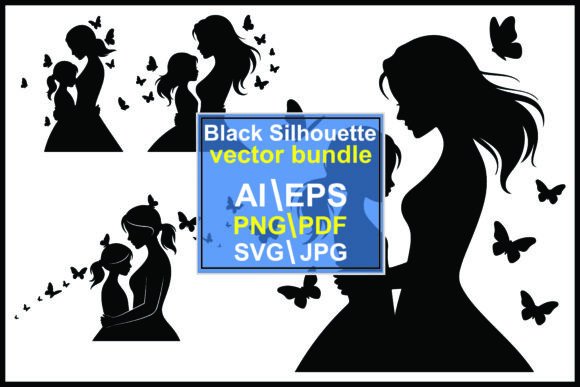
When I first opened Silhouettes of Women and Girls Butterfli, I didn’t see a graphic—I saw a pause. A breath held between mother and daughter, hair lifting slightly in an imagined breeze, butterflies hovering just above their shoulders like soft punctuation. It’s not loud or busy. It’s black-and-white silhouette work with gentle curves, intentional negative space, and a quiet emotional weight. As an embroidery designer who’s stitched hundreds of family-themed pieces for boutique clients and Etsy sellers, I immediately pictured it on a linen tea towel for a baby shower gift—or centered on the back of a relaxed-fit cotton sweatshirt for a small shop’s spring collection.
Where This Design Lives Best (and Where It Doesn’t Rush In)
Silhouettes of Women and Girls Butterfli thrives where storytelling meets simplicity: embroidered patches for denim jackets, pillow covers for nurseries, custom aprons for mother-daughter baking kits, or minimalist tote bags sold at craft fairs. Its clean outlines translate beautifully into satin stitch borders and smooth fill stitch areas—no jagged edges to fight during hooping or digitizing. I tested a similar silhouette-based file last month on a medium-weight cotton poplin tote bag, and the result felt intentional, handmade, and emotionally resonant—not generic.
It’s less ideal for high-detail applications like tiny cap fronts or curved bill embroidery, where fine butterfly wing lines could blur or stitch unevenly. On stretchy knits (think baby onesies or lightweight t-shirts), you’ll need a firm cutaway stabilizer and possibly slight underlay reinforcement—especially around the outer silhouette contours—to prevent puckering. And while the design reads clearly on light fabric, test it carefully on dark backgrounds: black thread on navy twill can mute the delicate scale of the butterflies unless you add a subtle white underlay or switch to a high-contrast thread like bright white or silver-gray.
Real Use: From Mockup to Market
Last week, I prepped Silhouettes of Women and Girls Butterfli for a client’s line of personalized nursery decor. We used it as the central motif on 12x16” organic cotton pillow covers—embroidered with matte black thread, medium-density fill, and a lightweight tear-away stabilizer. Customers responded strongly to the warmth and timelessness of the image. One buyer wrote, “It doesn’t look mass-produced—it looks like something made *for* us.” That’s the value here: this isn’t clipart. It carries tone, relationship, and restraint—qualities that elevate a handmade product beyond decoration into meaning.
For Etsy sellers and small shop owners, that emotional resonance directly supports pricing confidence. You’re not selling a butterfly silhouette—you’re offering visual shorthand for bonding, intergenerational love, and quiet joy. That matters when customers scroll past dozens of similar listings. It also works well in printable mockups: drop it onto a neutral sweatshirt or tea towel template, and it instantly reads as cohesive, boutique-grade design—not filler.
What to Check Before You Stitch
- Test on scrap fabric first—especially if using textured weaves (like canvas or burlap) or loosely woven linens where fine details may sink or fray.
- Review stitch density: Overly dense fills can overwhelm the delicate shape; aim for 20–30% density in butterfly wings and open areas to preserve airiness.
- Confirm hoop size compatibility: The composition suggests a mid-range layout—likely suited to 4x4” or 5x7” hoops—but verify before digitizing or scaling.
- Inspect small details: Are butterfly antennae or hair strands defined enough to survive stitching at 3” height? If not, a light trace-and-adjust pass in your embroidery software helps.
- Use proper stabilizer: Cutaway for knits and lightweight wovens; tear-away for stable cottons and linens. Skip fusible web unless you’re doing applique—this is a true silhouette design, not a layered motif.
- Check licensing: Since this falls under Illustrations and Graphics, confirm whether commercial use (e.g., selling finished embroidered pillows or digital embroidery files) is permitted. When in doubt, contact the seller—many independent designers grant broad rights but require attribution or limit resale of unaltered digital files.
Why It Builds Trust—Not Just Texture
In my decade reviewing embroidery assets for creative entrepreneurs, I’ve learned one thing: customers don’t buy stitches—they buy intention. Silhouettes of Women and Girls Butterfli signals care. Its balance of figure and flight, stillness and motion, makes it feel considered—not algorithmically generated. That perception lifts perceived value, increases repeat engagement, and strengthens brand consistency across products. Whether you’re embroidering holiday gifts for a local boutique or building a cohesive line of motherhood-themed digital embroidery files, this design holds its ground without shouting.
It also avoids trend fatigue. Unlike floral monograms or seasonal motifs that date quickly, this speaks to enduring themes—family, tenderness, growth—that remain relevant year after year. For craft business owners juggling inventory, that longevity means fewer redesigns and more reliable customer recognition.
A Final Note on Real Craftsmanship
This isn’t a “set it and forget it” machine embroidery design. It rewards attention: thoughtful thread selection, appropriate stabilizer pairing, and respect for fabric behavior. Used well, Silhouettes of Women and Girls Butterfli becomes part of a larger story—one your customers feel, recognize, and remember. It fits naturally into custom apparel, baby embroidery, holiday embroidery, and commercial embroidery projects where authenticity matters more than flash. Just remember: let the silence in the design speak. Don’t over-stitch it. Don’t over-market it. Let the butterflies do their quiet work.